Guide to HRSA Grants for Healthcare Simulation


*This guide is for educational purposes and does not replace official HRSA Notices of Funding Opportunity or federal guidance.*
HRSA (Health Resources and Services Administration) simulation grants are a strong option for institutions looking to expand simulation technology and strengthen healthcare workforce training infrastructure. Having a clear guide to the grant process can help institutions strengthen the workforce they are investing in.
Several HRSA programs explicitly support simulation-based training and simulation equipment as a way to strengthen the nursing pipeline and improve readiness to practice.
HRSA Funding Pathways Commonly Aligned with Simulation
The NEPQR (Nurse Education, Practice, Quality and Retention – SET (Simulation Education Training) Program is the big one for simulation.
Specifically designed to expand the training opportunities for nursing students, the NEPQR-SET program focuses on simulation-based technology, including equipment, to improve readiness in clinical practice.
Note: If your goal is simulation expansion and workforce readiness, this is often the cleanest fit.
When filling out the applications, find a logical spot for simulation in your story. Reviewers are going to be looking for the outcomes they want to fund: readiness, retention, rural access, underserved impact, and clinical competence.
What Reviewers Want to see in your Application
When writing your HRSA simulation proposal, use this flow:
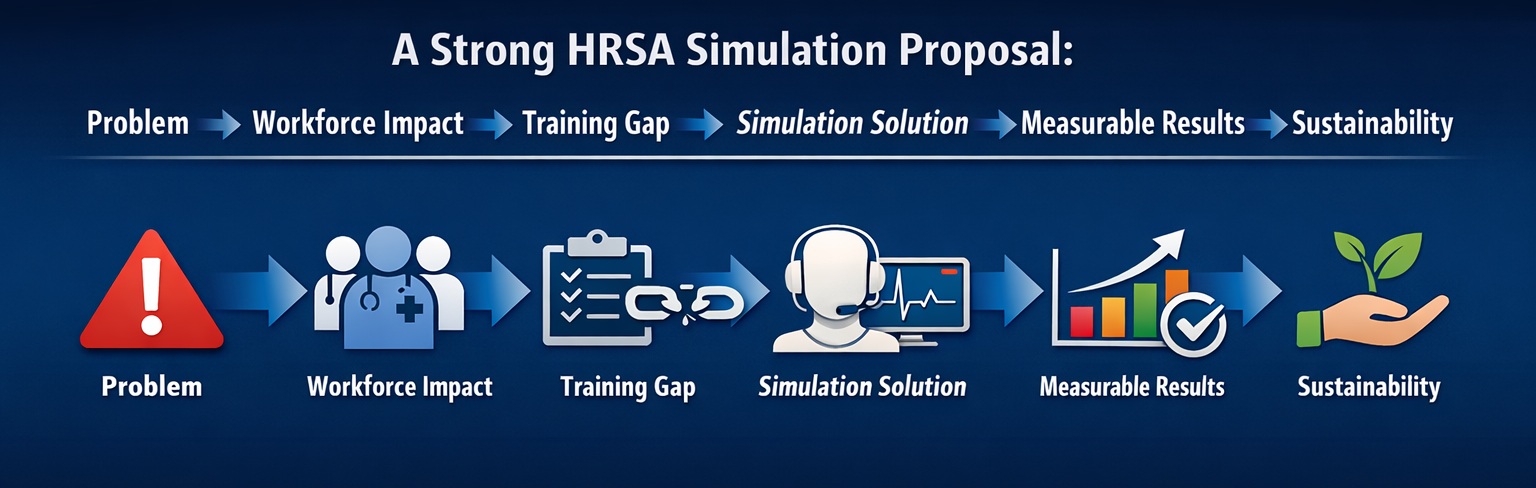
Because HRSA is so specific, funding readiness and implementation capacity matter more than simply purchasing equipment. With that in mind, focus on outcomes that you can measure, report, and defend.
Some examples:
- Number of learners trained by program type
- Competency checkoff pass rates / remediation
- Clinical placement bottleneck reduction (time-to-placement, slot capacity)
- Readiness-to-practice metrics (OSCE-Style performance, validated rubrics)
- Retention outcomes (where applicable to the program goals)
- Rural/underserved learner pipeline (rotations served, sites supported)
When planning the application, make sure every equipment line item is tied to a specific training activity and measurable outcome.
How the Application Process Works
One of the biggest challenges we see is that applicants lose eligibility or significant time on registrations rather than focusing on the proposal.
Mandatory registrations you need to do first include SAM.gov registration (gives you a UEI) and Grants.gov account/workspace to actually submit the package. HRSA explicitly warns these steps can take time and you should start early.
The HRSA grant build: a step-by-step playbook
Step 1: Identify the right NOFO and confirm eligibility
-
- Start on HRSA’s most updated funding listing and program pages. Then confirm that you fit:
- Into the eligible applicant types (school, health system, consortium, AHEC, etc.)
- Are of focus for service (Rural, underserved, high-need)
- Priority pain points (often equity and high-need geographies)
- Start on HRSA’s most updated funding listing and program pages. Then confirm that you fit:
Step 2: Build your project “spine”
-
- In this step, you are going to be putting together all of your ideas so that you can easily reference this sheet and your hyperfocused thoughts while filling out the application. Make sure to include:
- Need Statement (what’s broken, who it hurts, where)
- Target Learners (how many, programs, demographics where relevant)
- Training Model (Simulation activities mapped to competencies)
- Partners (clinical sites, schools, workforce boards)
- Evaluation Plan (What you’ll measure + how often)
- Sustainability (what happens after the grant)
- This becomes your master reference so the narrative, budget, and attachments stay consistent
- In this step, you are going to be putting together all of your ideas so that you can easily reference this sheet and your hyperfocused thoughts while filling out the application. Make sure to include:
Step 3: Design the Simulation Program Trainings and Activities
-
- Define:
- Scenario Categories
- Frequency
- Faculty Training
- Learner throughput model
- Define:
Step 4: Build the Budget + Budget narrative
-
- HRSA expects that applications will have budgets that align with the work plan and follow federal cost rules and program guidance. For your convenience, HRSA provides detailed application guides and budget expectations.
- HRSA allows simulation equipment purchases under many workforce training grants when they are directly tied to educational activities and measurable workforce outcomes.
Step 5: Validate your procurement reality
-
- So that you don’t create a post-award mess, make sure that your procurement process is aligned with all of federal procurement rules and your organization’s policies. You can’t always “just pick a vendor.” Plan quotes, competition requirements, and timelines accordingly.
- Research 2 CFR 200.320.
- This is the federal rule that tells grant recipients how they are allowed to buy things with federal money and protects federal dollars from being wasted or sent to an undeserving organization/person.
- Research 2 CFR 200.320.
- So that you don’t create a post-award mess, make sure that your procurement process is aligned with all of federal procurement rules and your organization’s policies. You can’t always “just pick a vendor.” Plan quotes, competition requirements, and timelines accordingly.
Step 6: Submit
-
- Use Grants.gov Workspace properly, and follow the HRSA application guide instructions. If HRSA requires Electronic Handbook (EHB) steps for your opportunity, make sure your team has accounts and roles set up.
What to Include in your Narrative
The narrative you are sending in your application is just as important as the research into the products and their outcomes that you’re seeking. Ensuring the reviewer clearly understands your program design and the supporting data will help your proposal stand out.
First, lay out the needs and who benefits from your being awarded the funding. Focus on data on shortages, placement constraints, training bottlenecks and risk, and learner volume issues receiving this money would help to solve.
Then lay out your training model. This is exactly what simulation will be delivered with the use of the products you are requesting money for, as well as the learner’s progression through simulation training. Start with the baseline, then move into practice, explain the assessment that will be used to grade the learner and the remediation to take place.
After that, include an evaluation plan that is tight and credible. Include process measures, performance measures and impact measures to show the number of sessions and learners trained, how performance will be measured, and the impact of the products and simulations that the HRSA grant will fund.
Lastly, lay out a sustainability plan. HRSA is going to want to see how you plan to keep this process after receiving the funding. Share with them specifics like:
- Absorbed costs
- Shared regional simulation model
- Train-The-Trainer to reduce reliance on outside support
- Maintenance and refresh cycle
Need Help Designing a Simulation Grant Proposal?
Our team helps institutions align simulation programs with HRSA funding priorities.