
Blog
Beyond the Skills Checklist: Bringing Critical Thinking into the Skills Lab

Beyond the Skills Checklist: Bringing Critical Thinking into the Skills Lab
A recent survey found that 86% of nurse educators are actively looking for ways to build critical thinking and communication skills into every part of nursing education. Educators across the country are recognizing that a scaffolded learning approach and equipment purchases is the direction nursing education is going.
The hard truth: the more we look at the classroom, skills lab, simulation, and clinical rotations as all separate experiences, it does a disservice to the learners when they get to bedside. Being able to include communication and critical thinking into every stage of learning will produce nurses better prepared for the next NCLEX and more importantly better prepared to take care of real patients at the bedside.
So how do we start to close the gap between these four key areas in nursing education?
What Educators Told Us
We recently asked educators how their skills labs run, and we got answers from nursing programs across the country.
74% of respondents want to incorporate more role play and human connection throughout their nursing curriculum. As conversations around the Next Generation NCLEX emphasize clinical judgment, programs are prioritizing realistic learning experiences that help students think critically, connect with patients, and apply their skills.
The barrier is the build. 97 named curriculum development as a barrier, and prewritten station curriculum rated 4.2 out of 5 in importance. The hard part usually isn’t believing in role play. It’s finding the hours to design it. This is where Avkin’s team of CHSE and CHSE-A team members are spending their time reducing this burden for the program. Developing easy to use templates that can be used by nursing faculty to move away from a checklist and lean into real world scenarios that include skills learning.
The Competency Gap
Traditional skills labs are organized around isolated tasks. Learners rotate through stations, practice on a static task trainer, and get checked off against a list of critical steps. This approach is efficient, measurable, and necessary but this is teaching toward the test not a real life experience.
a plastic task-trainer arm doesn’t flinch. It doesn’t ask questions, get anxious, or show the subtle changes in condition that real competency demands. Without a patient attached to the procedure, learners practice the science of the skill but miss the art: gathering objective data while communicating with a person throughout the procedure.
Learners can be technically accurate in the skills lab yet unconsciously incompetent at the bedside. Closing that gap doesn’t necessarily mean adding lab hours. It means rethinking how the hours you already have are being spent.
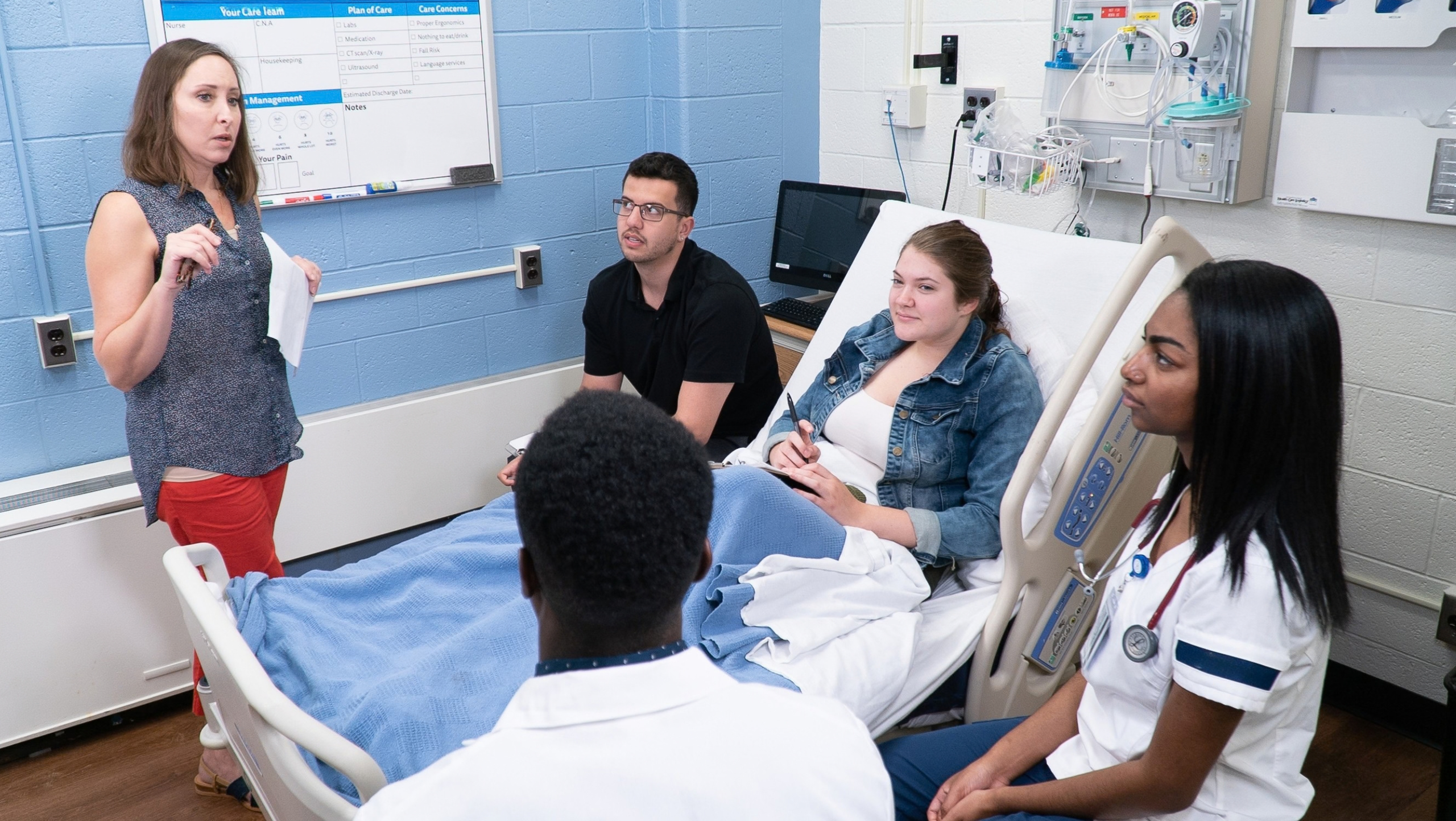
Adding role play brings greater depth to skills stations by embedding critical thinking, empathy, and communication into hands-on practice. Students learn by providing care, stepping into the patient’s role, and observing how their peers communicate. This scaffolded approach builds skills and confidence over time, helping students feel better prepared for simulation and real-world care.
Role Play: Learners as Both Clinician and Patient
Role play is one of the most accessible ways to bring the patient back into skills practice. When learners alternate between roles, each perspective builds something different.
As the clinician, the learner explains the procedure, obtains consent, monitors the patient’s response, and adjusts their approach. As the patient, the learner experiences care from the other side, which builds empathy and sharpens awareness on how they would want to be communicated with as the patient.
Wearable Simulators: Where Role Play Meets Real Procedures
Role play alone has a limit on what skills students can learn. Learners can’t safely perform invasive procedures on one another. Wearable simulators change that.
Worn by a live person, a wearable simulator replicates realistic anatomy and uses haptic feedback to cue the wearer to respond appropriately. Learners perform hands-on procedures while interacting with a responsive human patient, just as they will in clinical practice.
Avkin’s wearable simulators include:
- Avstick for IV insertion
- Avcath for urinary catheterization
- Avtone for auscultation
- Avtrach for tracheostomy care
- Avthor for chest tube care
- Avline for central line care
- Avwound for wound care
- Avbirth for childbirth
Because they move easily between classroom, skills and simulation, the same products grow with your program. Put an Avkin wearable on a role player and the skills station becomes a patient encounter. Once learners have built the skill through role play, the same simulators carry straight into full human simulation. Hands-on skills and human interaction happen together, building consciously competent clinicians and shortening the gap from academia to the bedside.
Programs are Already Seeing the Results
At Maine College of Health Professions, first-year nursing students used Avkin wearables in scheduled role-play activities throughout their first-semester skills lab course. Students prepared their patient roles a week ahead and rotated through skills stations, connecting their understanding of disease processes with the experience of both giving and receiving care.
Dean Emeritus Lynne Gotjen, PhD, MSN, RN, reported unanimously positive end-of-course feedback and measurable improvement in Fundamentals and Health Assessment NCLEX prep scores. The biggest gains were in communication, empathy, and professionalism. Her experience shows how human simulation can become part of a program’s foundation and scaffold across the curriculum.
Take the Next Step
Are you looking to implement more human connection across your nursing curriculum? Moving from a single role-play activity to a full human simulation program doesn’t happen overnight, but it doesn’t have to be overwhelming either.
Download our free ebook: A Practical Guide from Peer-to-Peer Role Play to Full Human Simulation Program. From your first skills-lab role-play activity to a mature standardized patient program, it offers step-by-step guides and practical tips for every stage.
Ebook – Bringing People Back Into Simulation
Five Stages to Building a Sustainable Human Simulation Program From Peer-to-Peer Roleplay to a Fully Developed Program